Product Overview
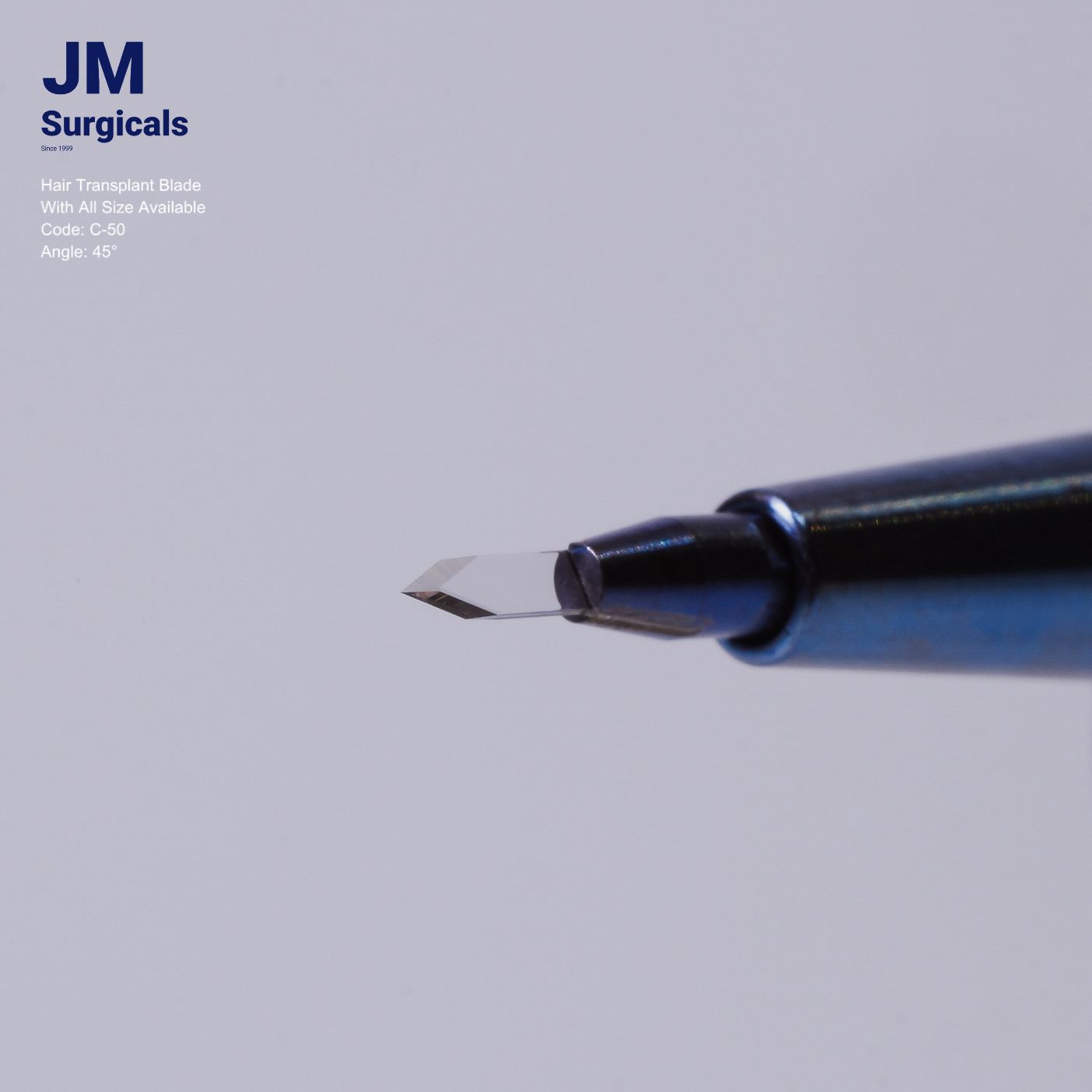
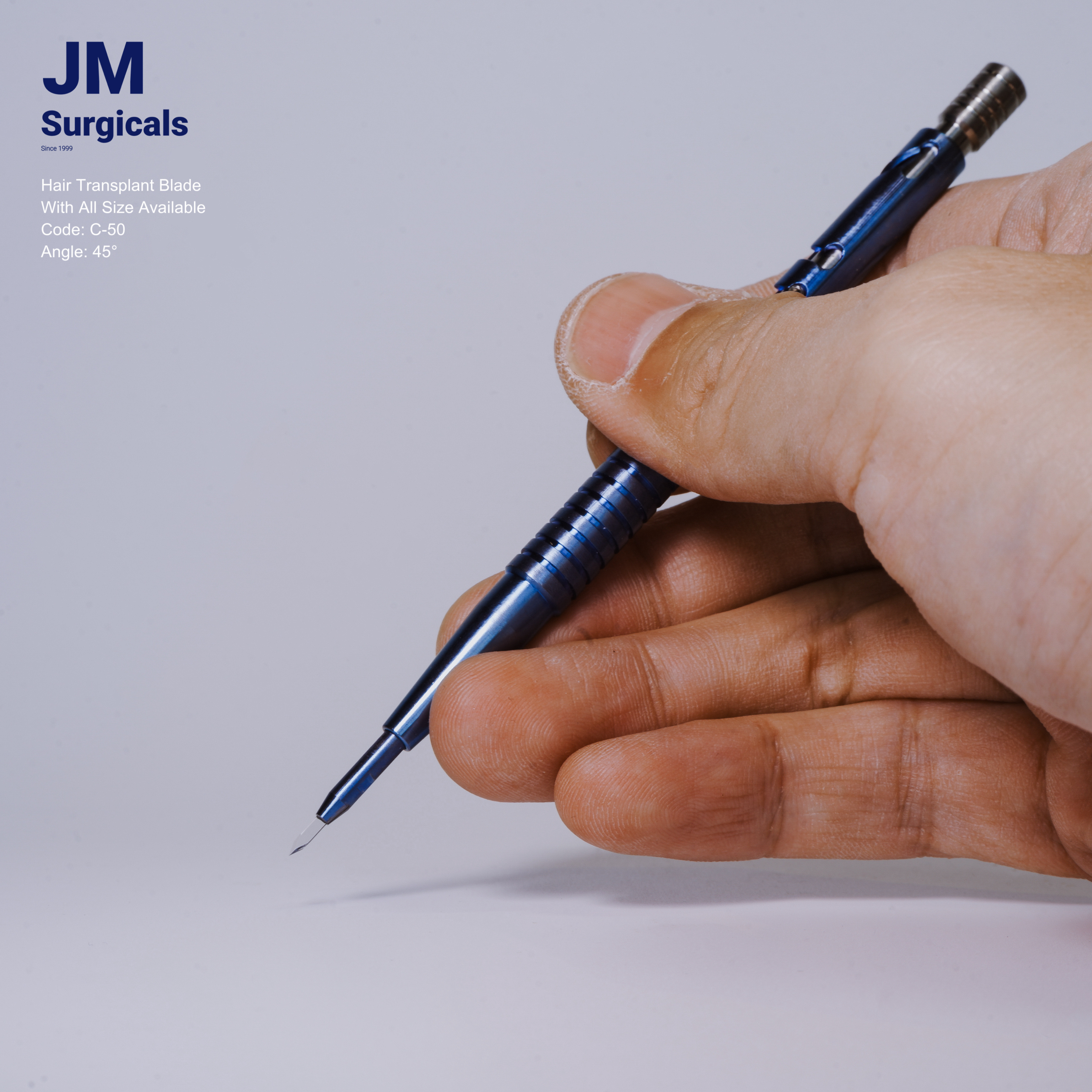
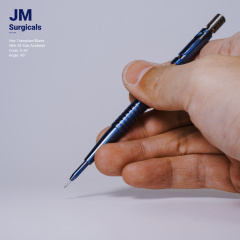
The recipient site is where an FUE result is won or lost, and the sapphire hair transplant blade is the instrument that makes it. Each one is a synthetic sapphire cutting edge set into a titanium handle, built for opening the slit or channel that receives a graft during follicular unit extraction. It is used in theatre every working day, cleaned and re-sterilised between cases, and it has to behave the same way on the last case of the week as it did on the first.
The range is deliberately broad rather than a single size, with closely spaced widths, so a surgical team can standardise on one handle, one case and one way of working while still matching the channel to the case in front of them. Every one of them is an ultra sharp fue blade of the same construction; only the dimensions change.
These blades are bought by hair restoration surgeons who sign off on their own instruments, by clinic owners and practice managers sourcing consumables for a team, and by distributors assembling a hair transplant line for their clinic customers. Most arrive from a steel blade, or from a supplier who could not offer the width their technique needed. Neither problem survives a full range.
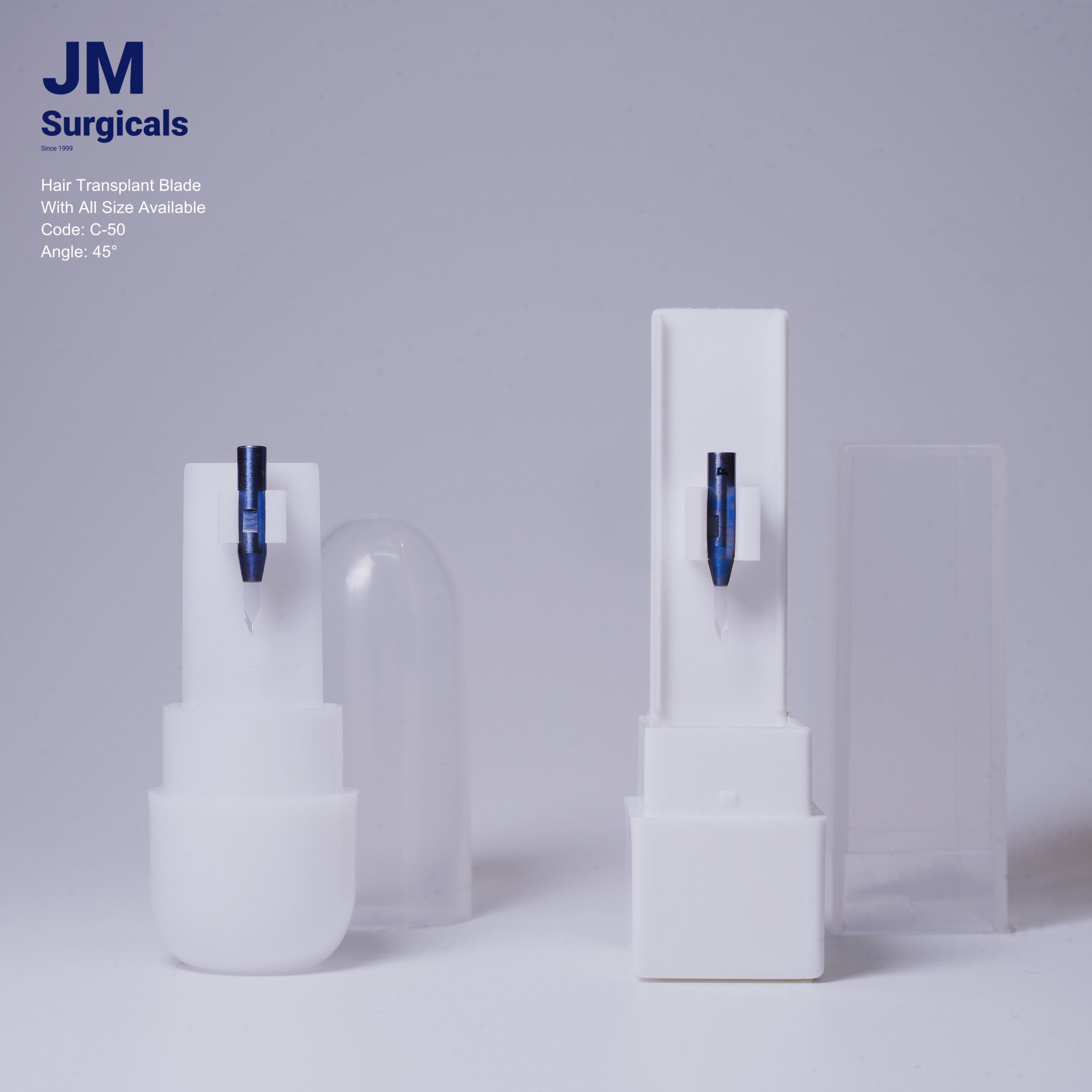
Day to day the blade lives in its heat-resistant case, comes out for the case list, is mounted in the handle, and goes back through reprocessing afterwards. Teams working at volume tend to keep two or three widths open at once rather than changing a single blade between patients, and they reorder the same specification rather than re-deciding it.
Specifications
| Model |
C-50 |
| Blade material |
Synthetic sapphire |
| Handle material |
Titanium |
| Blade width |
0.7 mm, 0.75 mm, 0.8 mm, 0.9 mm, 1.0 mm, 1.05 mm, 1.1 mm, 1.15 mm, 1.2 mm, 1.25 mm, 1.3 mm, 1.35 mm, 1.4 mm, 1.5 mm, 1.6 mm, 1.7 mm |
| Blade thickness |
0.25 mm |
| Blade length |
4.5 mm, 5.0 mm, 5.5 mm |
| Cutting angle |
45°, 60° |
| Blade appearance |
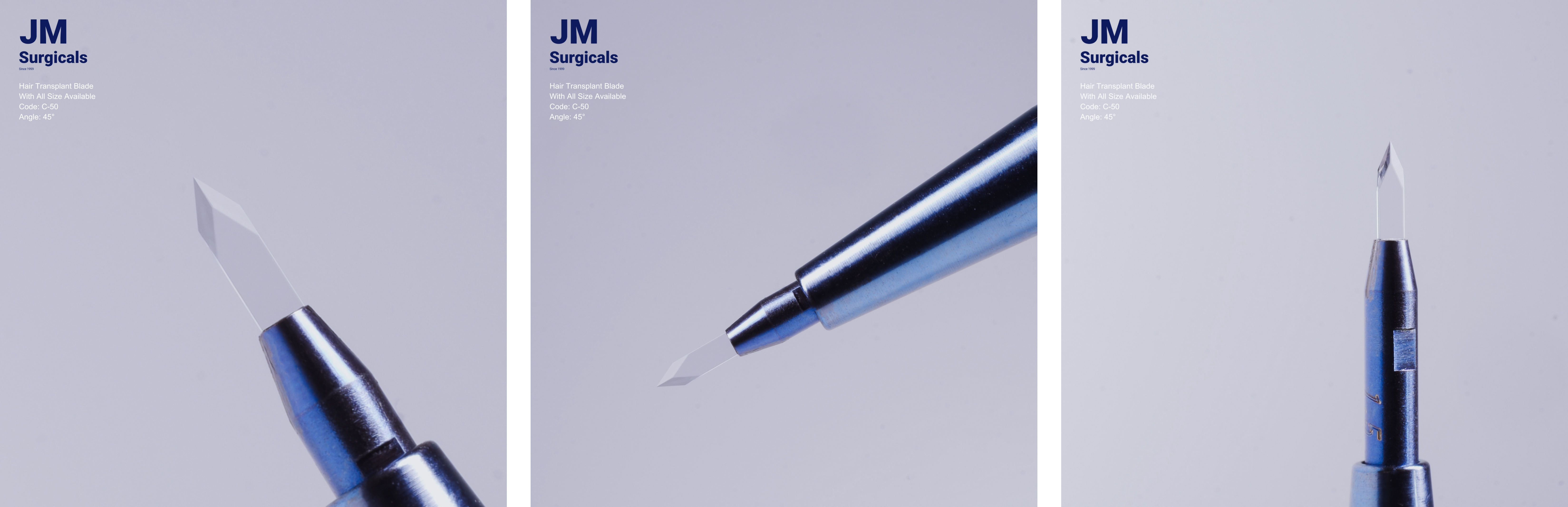
Clear sapphire body with a hand-polished edge |
| Handle options |
Blue or silver |
| Case |
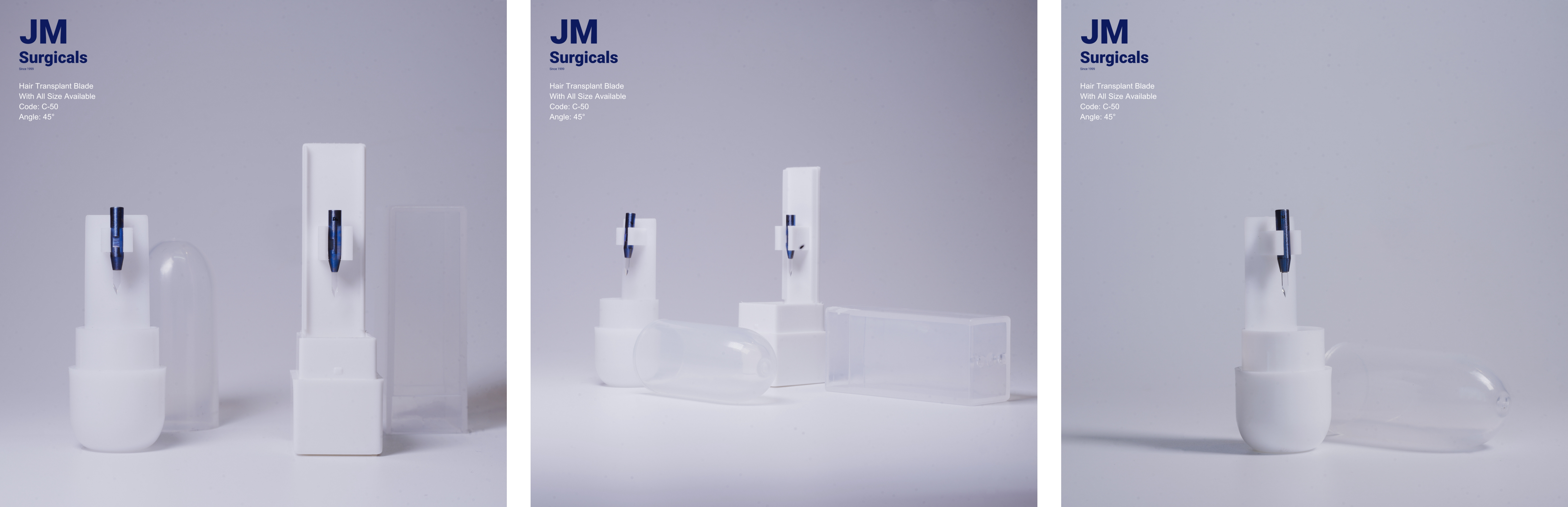
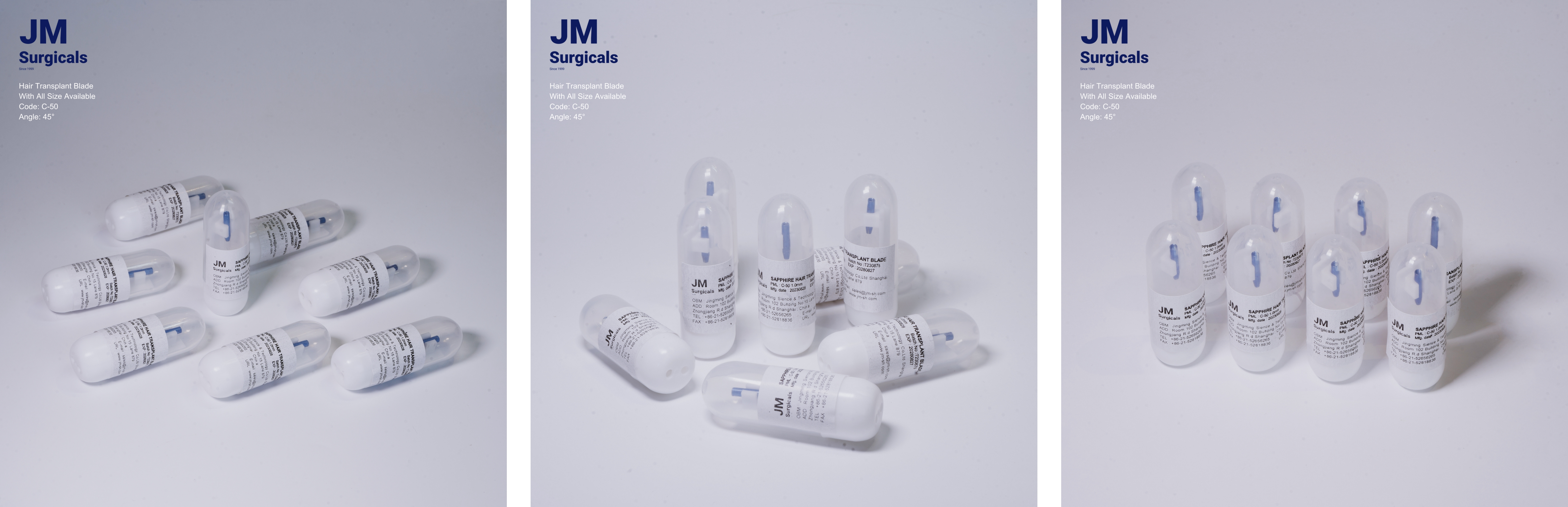
Heat-resistant plastic, three styles, dust cover per blade |
| Device classification |
Class I medical device |
| Quality certification |
ISO 13485 |
| Safety standard |
National standard |
| Shelf life |
5 years |
Blade Geometry & Size Selection
- Width decides the incision footprint. The range steps in fine increments, so you can move a fraction of a size when a case asks for it instead of jumping to an unrelated instrument; where the ladder stops, a custom size FUE blade is confirmed from the dimensions your technique needs.
- Length decides how deep the channel reaches. Blades are supplied in three lengths so channel depth can be matched to the graft length and to the depth your placement technique relies on.
- Angle changes how the slit sits in the skin. The two options give different channel geometry; most surgeons settle on the one their technique is built around and keep it fixed across the team.
- Thickness stays constant, so moving up or down a width does not change how the instrument feels in the hand, and a surgeon can change width between cases without relearning the tool.
- Choose by case, then standardise. Narrow widths suit fine, tightly packed recipient work where the smallest possible site matters; the wider end gives more room in the channel for larger graft units and denser packing.
- Trial a step before committing. When a team moves from another fue hair transplant blade to this range, ask your sales contact about trialling two neighbouring widths on a real case list — the difference is easier to feel than to describe.
Sapphire Material & Edge Retention
Why sapphire rather than steel
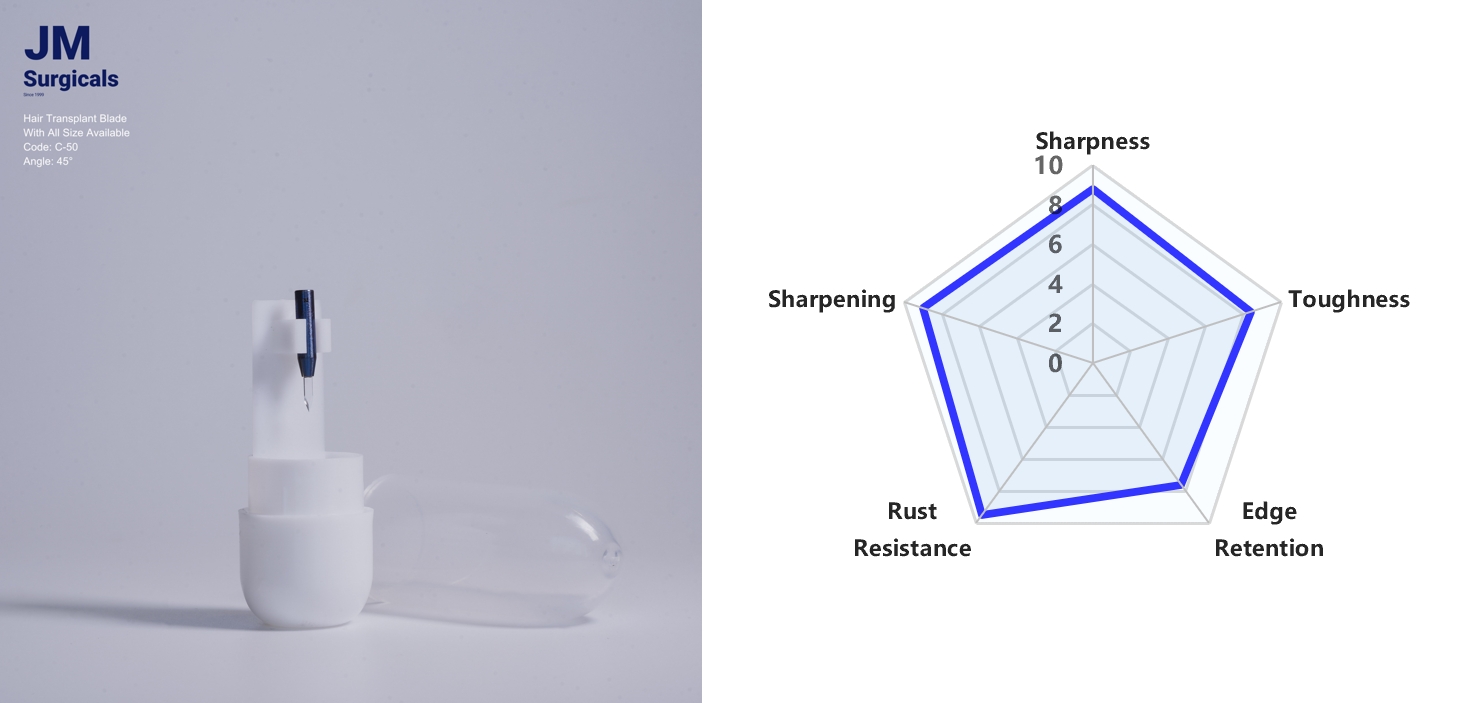
The cutting edge is synthetic sapphire, one of the hardest materials used for a surgical blade. For your clinic, that means edge retention: the blade keeps its sharpness through a full case list and repeated sterilisation, while a steel edge starts to drag. It is also corrosion resistant, which matters in a humid sterile field and inside an autoclave chamber.
Hand-polished, then checked
We hand-polish every blade before mounting it. Polishing is the step that turns a hard edge into an ultra-sharp FUE blade — it refines the bevel so the cut is clean, the channel walls stay smooth and the surrounding follicular zone is left as undisturbed as the technique allows.
The titanium handle
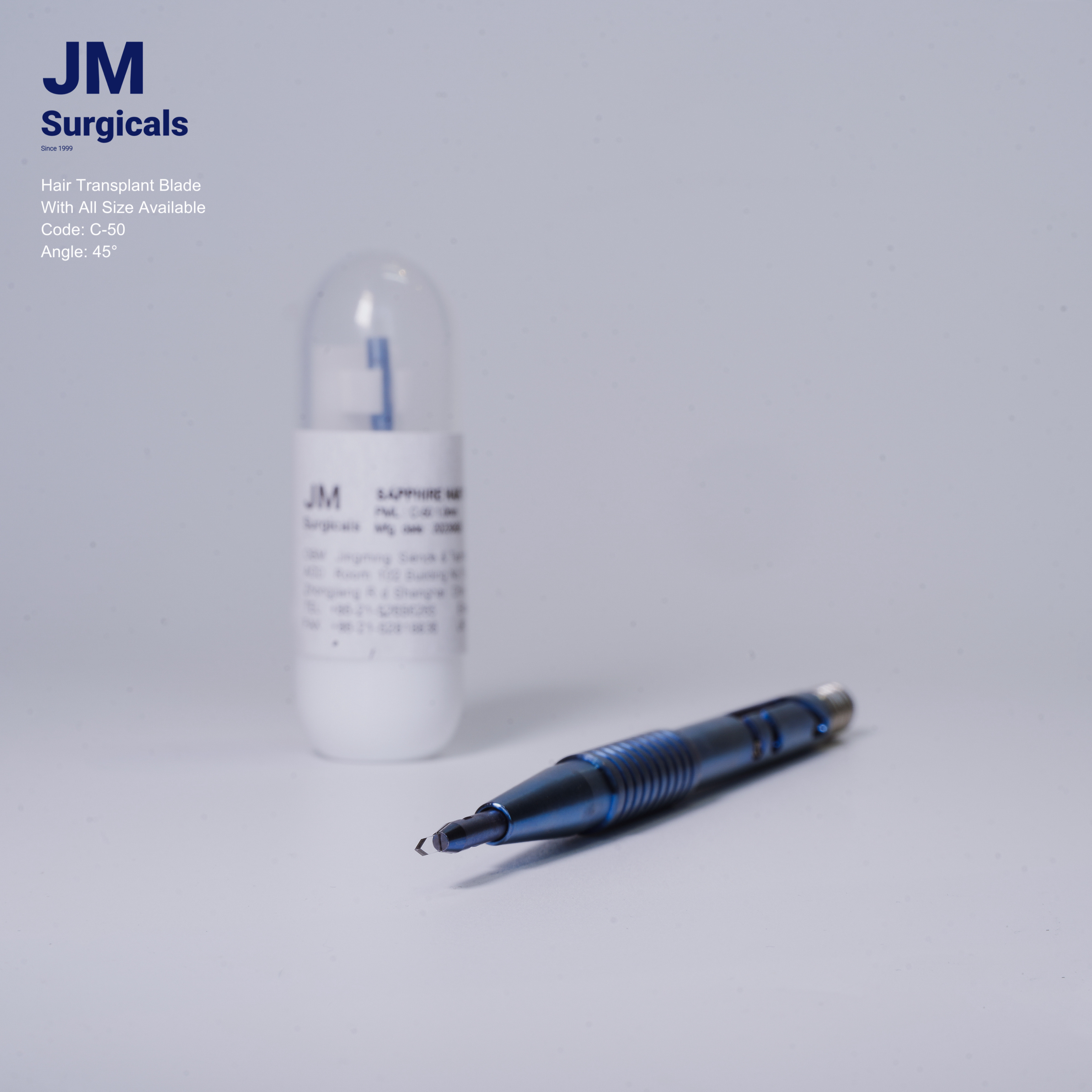
The blade seats into a titanium handle, supplied in blue or silver with a ridged grip. Titanium keeps its finish through repeated cycles, adds very little weight to the assembly, and gives the surgeon a secure, consistent hold during long sessions when the wrist begins to tire.
Built in our own workshop
We make the blades in our own sapphire surgical blade factory in Shanghai rather than sourcing them from a third party, so polishing, inspection and dimensional checks follow the same routine whether you order one width, the whole ladder or a custom size FUE blade. We have been making surgical instruments in Shanghai since 1999.
What that changes in theatre
Fewer mid-case blade changes, channel dimensions that repeat from patient to patient, and a blade whose feel does not shift between batches — the three things your surgical team will notice first when you change supplier.
Clinical Applications
- High-volume FUE clinics. A centre running several cases a day standardises on one sapphire hair transplant blade specification so the whole team works to the same channel geometry, and keeps two or three widths open rather than swapping a single blade between patients.
- Single-surgeon practices. A smaller practice wants one width it trusts, one handle and a reorder that arrives without renegotiating anything; the range lets it hold that line and add a second width only when the case mix demands it.
- Hairline and dense-packing work. Fine recipient work rewards the narrow end of the ladder, where the site is as small as the technique allows and the surrounding tissue is left intact for the next graft.
- Training and proctoring. Teaching programmes run a fixed blade specification so a trainee's incision quality reflects technique rather than a change of instrument, and the clear blade makes it easy to show what a clean channel looks like.
- Regenerative medicine and research. Laboratory groups use this sapphire fue blade for controlled follicular tissue sampling, where a consistent cut matters more than speed and the harvest has to stay intact for study.
- Distributor and private-label lines. Distributors stock a full width ladder rather than a single size, because their clinic customers arrive with different preferences; neutral packing or your own branding lets the range carry your label instead of ours.
Sterilisation & Reprocessing
- Inspect on arrival. Check the case, the dust cover and the edge under magnification before the first case — a habit worth keeping for every ultra sharp FUE blade you stock, because transit damage is far easier to catch before the blade reaches a sterile field.
- Clean straight after use. Remove biological debris with the protocol your facility uses for fine instruments, rinse thoroughly and dry the blade before it goes near the autoclave. Residue baked onto a polished edge is the most common reason a blade cuts less cleanly on its second use.
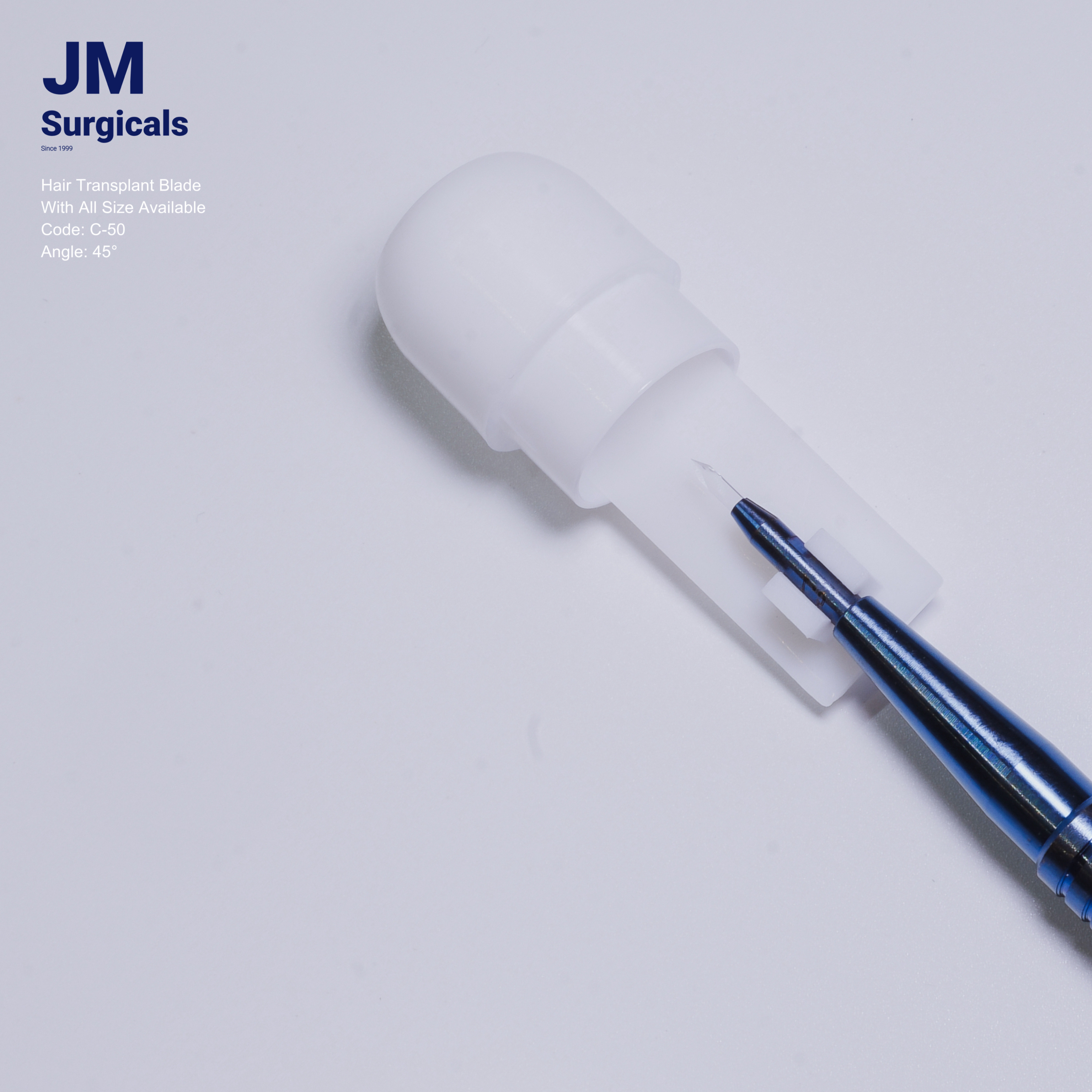
- Load it back into its case. The heat-resistant plastic case holds the blade steady and holds its own shape through a high-temperature cycle, so the edge is protected from contact damage while it is being sterilised.
- Run your validated high-temperature cycle. Sapphire is chosen partly because it resists corrosion under repeated autoclaving, so the edge is not the limiting factor here — the cycle protocol is. Use the parameters your facility has validated, and if you are setting up a new cycle, confirm them with our team rather than improvising.
- Cool fully, then inspect. Open the case only once it has cooled, and check the edge and the seating of the blade under magnification before it returns to theatre.
- Store or re-pack for the next case. Keep the blade in its dust cover and case between cases, and log the number of cycles if your protocol tracks instrument life.
Technical Data & Downloads
| Document |
What it covers |
| Product specification sheet |
Width, thickness, length, angle and material on one page, ready for your instrument file |
| Blade geometry note |
How cutting angle and channel shape relate during FUE planning |
| Sterilisation notes |
Case handling, loading and autoclave guidance for the blade and its case |
| Quality documentation |
The ISO 13485 reference and the Class I classification for your records |
| Packaging specification |
Case styles, dust covers and outer carton details |
| Custom specification sheet |
The dimensions we need from you to build a blade outside the standard list |
| Manufacturing |
Our sapphire surgical blade factory in Shanghai, in-house since 1999 |
Ordering & Delivery
- Set the specification. Give us the width, length and angle for each line you need. If the combination is outside the standard range, we confirm the exact dimensions we can hold before anything is scheduled.
- Choose the packaging. Blades ship in neutral packaging or in your own branding. Logo changes start at 300 pieces, graphic changes at 1,000 pieces and fully custom packaging at 5,000 pieces, so it is worth settling the packaging at the same time as the blade specification.
- Confirm the quantity. Overseas orders start at 100+ pieces. If you want to evaluate the blade on a real case list first, ask your sales contact about sample availability and what a trial quantity looks like.
- Confirm the lead time in writing. Orders of 1–500 pieces run at about 10 days; above 500 pieces the schedule is agreed case by case. Tell us your theatre dates and we will say honestly what is achievable.
- Production and dispatch. Production is scheduled at our sapphire surgical blade factory once the four points above are confirmed. Each blade goes into its heat-resistant case with a dust cover, and the cases travel in sturdy cardboard cartons that protect them in transit.
- After delivery. Every order carries a 12-month warranty and remote operation training for your team, so a new width or a new handle can be brought in without taking the theatre out of service.
Handle Compatibility
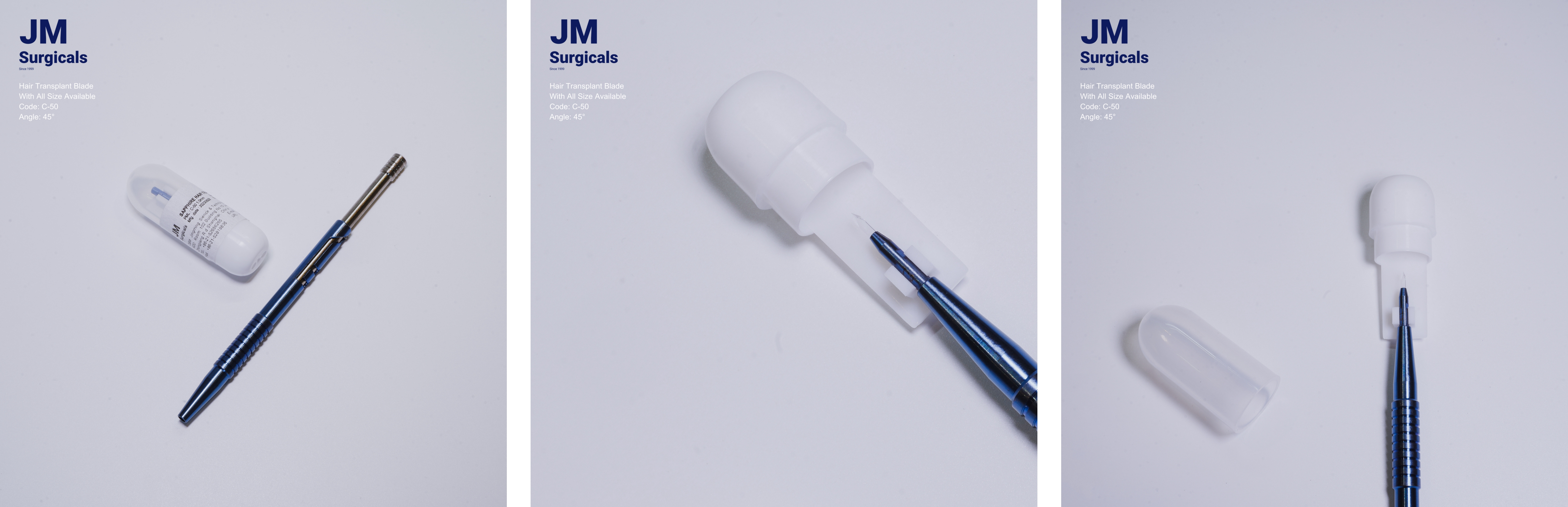
- Blade and handle are a matched pair. Every fue hair transplant blade we supply can be ordered already seated in its titanium handle — blue or silver — so the assembly arrives checked as one unit. For a new width, a surgeon joining the team or a first order, that is the simplest way to take fit out of the equation.
- If you want to keep the handle you already use, the mounting collar is the part that decides it. Handles vary in bore diameter, collar depth and the way the blade is held at the collar, and none of that can be judged from a product photo.
- Send us the collar rather than the whole handle. A clear photograph of the opening with a ruler or caliper laid across it is usually enough to start; add the model name if it is stamped on the handle and tell us roughly how old it is.
- Two measurements do most of the work: the internal diameter where the blade enters, and the distance from the collar face to the point where the blade is gripped. The first tells us whether the shaft will pass; the second tells us whether the blade will seat to full depth instead of sitting proud.
- A blade held slightly high still cuts, but not the way it was designed to. The bevel is set in the blade, so if the collar keeps it a fraction further out than intended, the channel it opens will not match the geometry your team planned around.
- Where no drawing exists, sketch it. A simple dimensioned sketch of the collar carrying those two measurements is as useful to us as a photograph, and we will confirm in writing whether the blade will seat properly before you commit to an order.
- Keep one handle per width on busy lists. Clinics running two or three widths in a session often leave each blade seated in its own handle rather than re-seating between patients — re-seating is where a polished sapphire edge is most often chipped.
- Check the seat on arrival. Fit the blade, hold the handle up to the light and look for rock or play at the collar; a blade that moves will not track the line you set. If anything feels loose, tell us before the first case rather than working around it.
- If a blade is not taken from the standard list, order the handle together with it and the seat is checked at our workshop before the assembly is packed and dispatched.
Technical Support & Model Matching
Because we manufacture in-house, technical questions go straight to the engineers who build the instruments. JM Surgicals has been a surgical instrument manufacturer since 1999, with a team of more than 100 people, and we work alongside clinics, hospitals, private surgeons and distributors to match the right specification to each surgeon's technique and existing instruments — and to say honestly when a custom size, neutral packing or own-brand packing suits the order better. Support carries on after delivery: our team answers handling, sterilisation and reprocessing questions, helps troubleshoot anything that behaves unexpectedly, and turns custom requests around quickly. Tell us what you need to achieve and we will confirm what we can build for you.
FAQ
Q1. What materials are used in the sapphire hair transplant blade?
The cutting edge is synthetic sapphire and the handle is titanium. Sapphire gives the blade its hardness and its edge retention; titanium gives the handle corrosion resistance and keeps the assembly light through a long case list. The blade body is clear sapphire with a hand-polished edge, and the handle is supplied in blue or silver.
Q2. Can I order custom blade sizes and packaging?
Yes. Width, length and cutting angle can all be built to your specification when the standard list does not carry what your technique needs, and we confirm the exact dimensions in writing before production starts. Packaging is available neutral or branded; your sales contact will confirm the current options and quantities for logo, graphic and packaging changes.
Q3. How should the blade be sterilised to ensure safety?
Use your facility's validated high-temperature autoclave cycle. Each blade sits in a heat-resistant plastic case that holds its shape through those cycles rather than deforming, and every blade carries a dust cover before first use. Clean and dry the blade before it goes in, let the case cool fully before opening, and check the edge under magnification before the next case.
Q4. What is the difference between the 45° and 60° angle options?
Both options are the same ultra sharp fue blade; the difference is how the cutting edge meets the scalp. The 45° blade enters at a shallower angle than the 60°, so the two produce different channel geometry and suit different placement techniques. Most teams try both across a case list and then standardise; if your surgeons already work to a fixed angle, keep it.
Q5. Will the blade fit the handle my team already uses?
The sapphire fue blade is supplied as a matched assembly with its own titanium handle, so ordering the two together is the simplest route. If you intend to keep an existing handle, send us a clear photo or a drawing of the mounting collar and we will tell you whether the blade will seat properly before you order.
Q6. How do you keep blade-to-blade consistency across batches?
Every sapphire fue blade is polished by hand and checked before it is mounted, and width, thickness and length are held to the same specification from one order to the next. Because the blades are made in our own workshop rather than bought in, a reorder is built on the same tooling as the original order. If a batch ever behaves differently from what you expect, tell us and we will investigate it against your specification.