• JM Surgicals | 1.1mm Sapphire Hair Transplant Blade C-50 | Precision FUE Blade, Ultra-Sharp, Scalp Microblades
  • JM Surgicals | 1.1mm Sapphire Hair Transplant Blade C-50 | Precision FUE Blade, Ultra-Sharp, Scalp Microblades
  • JM Surgicals | 1.1mm Sapphire Hair Transplant Blade C-50 | Precision FUE Blade, Ultra-Sharp, Scalp Microblades
  • JM Surgicals | 1.1mm Sapphire Hair Transplant Blade C-50 | Precision FUE Blade, Ultra-Sharp, Scalp Microblades
  • JM Surgicals | 1.1mm Sapphire Hair Transplant Blade C-50 | Precision FUE Blade, Ultra-Sharp, Scalp Microblades
  • JM Surgicals | 1.1mm Sapphire Hair Transplant Blade C-50 | Precision FUE Blade, Ultra-Sharp, Scalp Microblades
  • JM Surgicals | 1.1mm Sapphire Hair Transplant Blade C-50 | Precision FUE Blade, Ultra-Sharp, Scalp Microblades
  • JM Surgicals | 1.1mm Sapphire Hair Transplant Blade C-50 | Precision FUE Blade, Ultra-Sharp, Scalp Microblades

JM Surgicals | 1.1mm Sapphire Hair Transplant Blade C-50 | Precision FUE Blade, Ultra-Sharp, Scalp Microblades

No.PTC501100001
Product Name:
1.1mm Sapphire Hair Transplant Blade

Product Type:
FUE Hair Transplant Tool  

Features:
Ultra-Sharp Sapphire Blade

The 1.1mm Sapphire Hair Transplant Blade C-50 offers unmatched precision and durability for surgical procedures. This ultra sharp FUE blade, produced by a trusted sapphire surgical blade factory, ensures clean follicle extraction with minimal tissue trauma.


Model
C-50
Angle
45°, 60°
Width
1.1mm
Length
4.5mm,5.0mm,5.5mm
Thickness
0.25mm
  • JM Surgicals | 1.1mm Sapphire Hair Transplant Blade C-50 | Precision FUE Blade, Ultra-Sharp, Scalp Microblades
  • JM Surgicals | 1.1mm Sapphire Hair Transplant Blade C-50 | Precision FUE Blade, Ultra-Sharp, Scalp Microblades
  • JM Surgicals | 1.1mm Sapphire Hair Transplant Blade C-50 | Precision FUE Blade, Ultra-Sharp, Scalp Microblades
  • JM Surgicals | 1.1mm Sapphire Hair Transplant Blade C-50 | Precision FUE Blade, Ultra-Sharp, Scalp Microblades

Description

One Step Wider Than 1.0 mm

Hair transplant blade product image

The 1.1 mm sapphire hair transplant blade sits a single increment above the 1.0 mm width, and that extra 0.1 mm exists for one job: giving a 2- or 3-hair unit a little more room at the channel mouth while the incision stays small enough to close cleanly. Through the frontal and mid-scalp zones, where the packing plan is dense but the skin still has to settle back, the difference usually shows as a graft that drops in on the first pass instead of the second.

Each blade is ground, polished and inspected in our own sapphire surgical blade factory on equipment we have run since 1999, so a reorder arrives with the same edge geometry as the first box. Because the whole C-50 family shares the same body, moving up a width changes the channel rather than the way the instrument sits in your hand.

How the C-50 Widths Sit Together

Width Channel at the recipient site Cases it tends to suit
1.0 mm Tight, higher-friction channel that holds the graft Routine sessions where a unit is expected to grip
1.1 mm A little more room at the mouth 2- and 3-hair units in frontal and mid-scalp zones
1.2 mm Wider channel, less resistance on the pass Larger units, revision areas and firmer tissue

What Changes When You Step Up One Width

  • More room at the channel mouth: a 3-hair unit that needs a nudge to settle at the narrower width drops in on the first pass here.
  • Still a micro incision hair transplant blade: the step up does not push the incision out of micro-incision territory, and the tip still parts tissue with the light pressure the technique depends on.
  • The same body as its neighbours, so the blade does not feel stiffer or more flexible in the hand and a surgeon moving up from the narrower width does not have to recalibrate pressure.
  • Where the narrower width still wins: if your placement relies on the channel gripping the graft, the extra room works against you and the narrower width remains the better instrument.
  • Where the next step up wins: larger units, firmer revision tissue and a deeper channel point to the next width up rather than this one.

Balance in the Hand Across a Long List

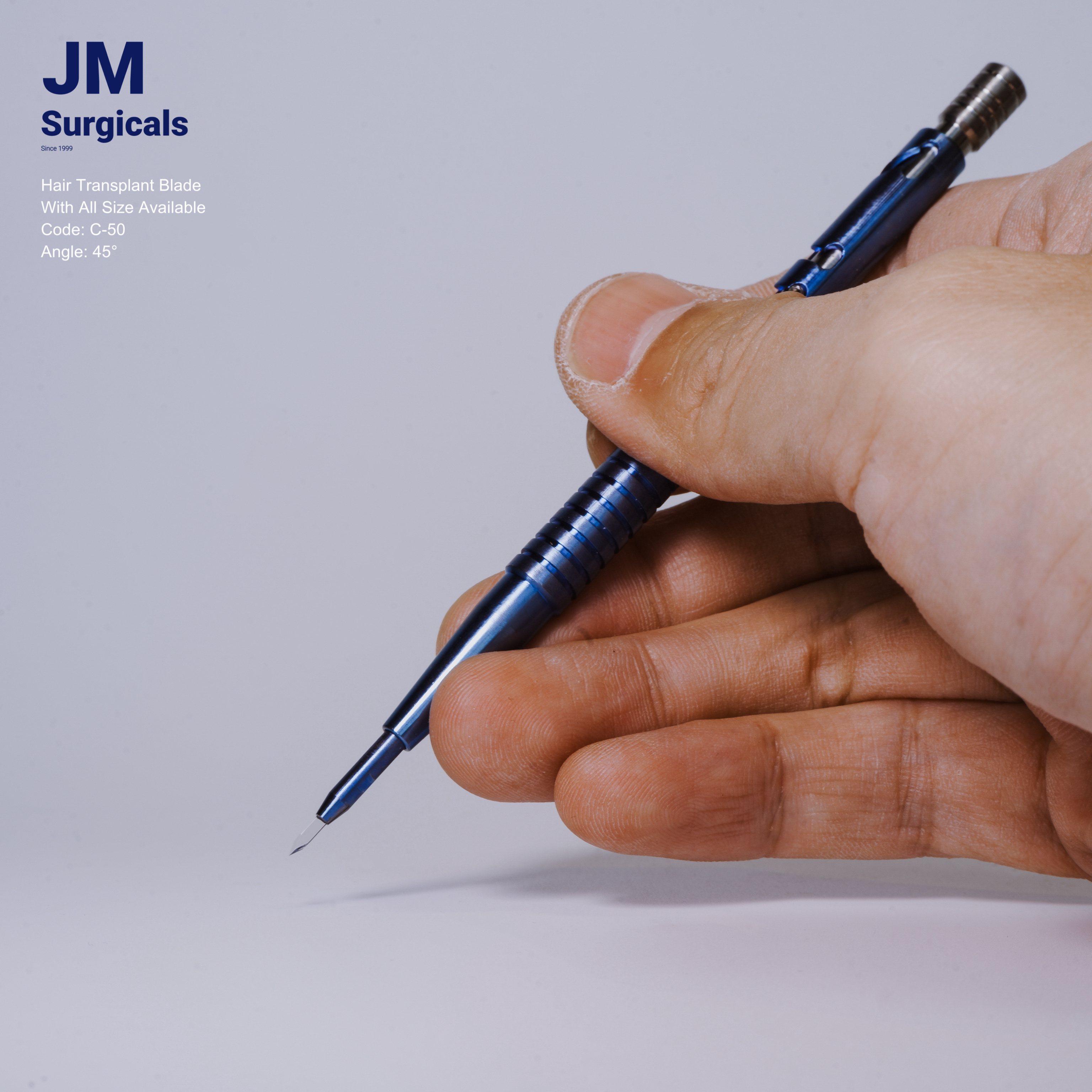
The blade mounts on a slim pen-style handle with a smooth taper, and that shape is what keeps a full list of recipient sites manageable: the wrist stays neutral, the fingers do the work, and depth changes come from the fingertip rather than the whole arm. Handles come in blue or silver, which gives a team a simple way to code widths on the tray without labelling every case.

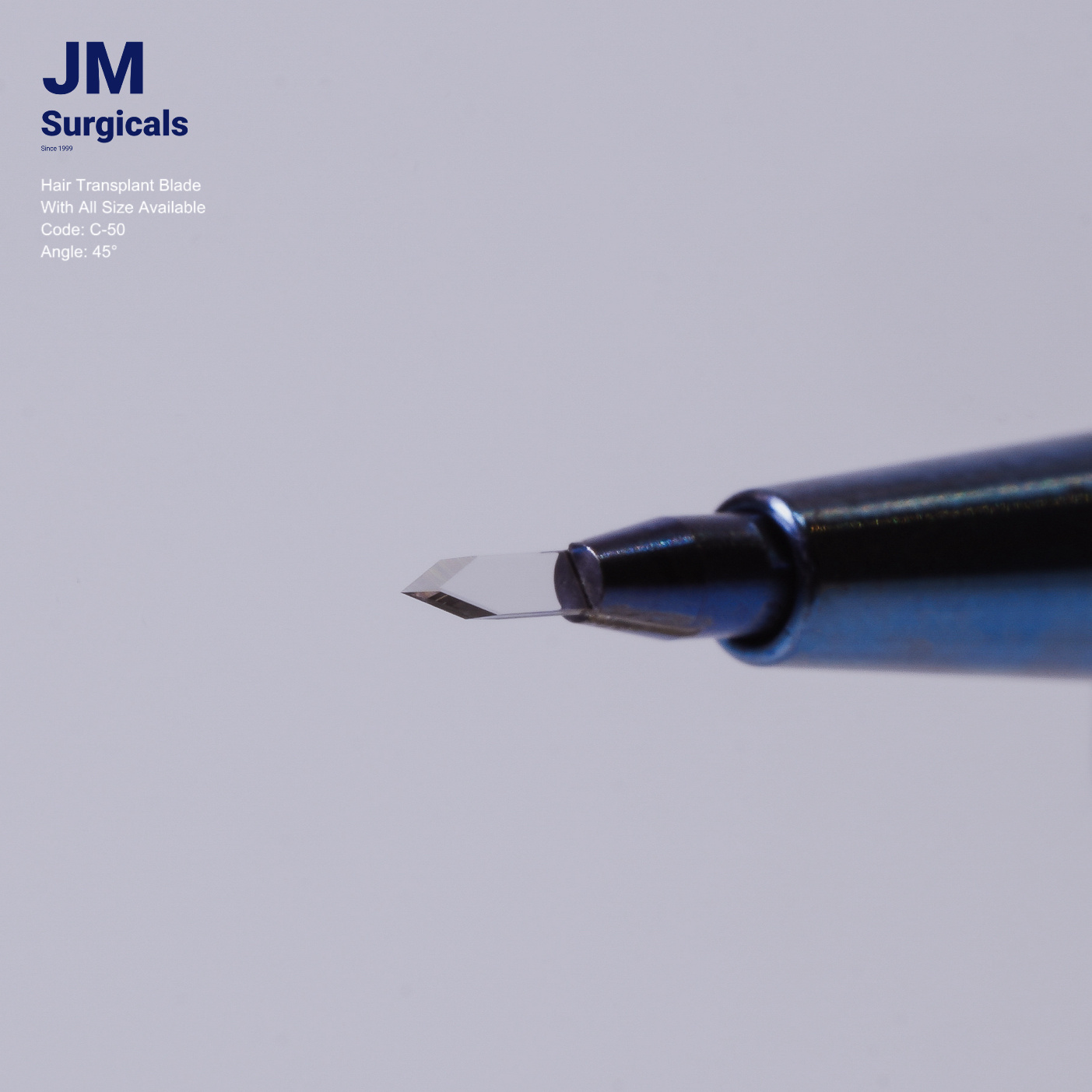
Each ultra sharp FUE blade is hand-polished at the tip, then checked under magnification for a continuous edge, because a burr or a chipped corner is what a surgeon feels first. The sapphire body is transparent, so the tip stays visible against the scalp instead of disappearing into the incision.

Macro close-up of blade tip and blue handle

C-50 1.1 mm Specifications

Sapphire blade in capsule with performance radar chart
Property Detail
Model C-50
Width 1.1 mm
Body thickness 0.25 mm
Working lengths 4.5 mm, 5.0 mm, 5.5 mm
Cutting angles 45° or 60°
Material High-hardness sapphire
Edge Hand-polished, inspected under magnification
Handle Pen-style, blue or silver
Sterilisation Compatible with repeated autoclave cycles
Quality system ISO 13485

Sterilisation and Handling Between Cases

  1. Leave the blade in its case until the case is opened in the sterile field, and never set it out on a bench or tray beforehand.
  2. Lift it by the shank. Sapphire holds an edge well, but a knocked tip cannot be re-ground in the clinic.
  3. Clean it promptly after use: residue left to dry on the bevel is the quickest way to dull an edge, and the polished surface wipes clean without abrasives.
  4. Run it through your validated autoclave cycle. Sapphire tolerates repeated high-temperature exposure, and the high-temperature resistant case is moulded to keep its shape through sterilisation.
  5. Dry it, reseat the dust cover and store it flat, away from heavier instruments that could rest against the edge.
  6. Retire the blade when the feel changes. An ultra sharp FUE blade should enter with almost no pressure; once you find yourself pushing, the edge has gone.
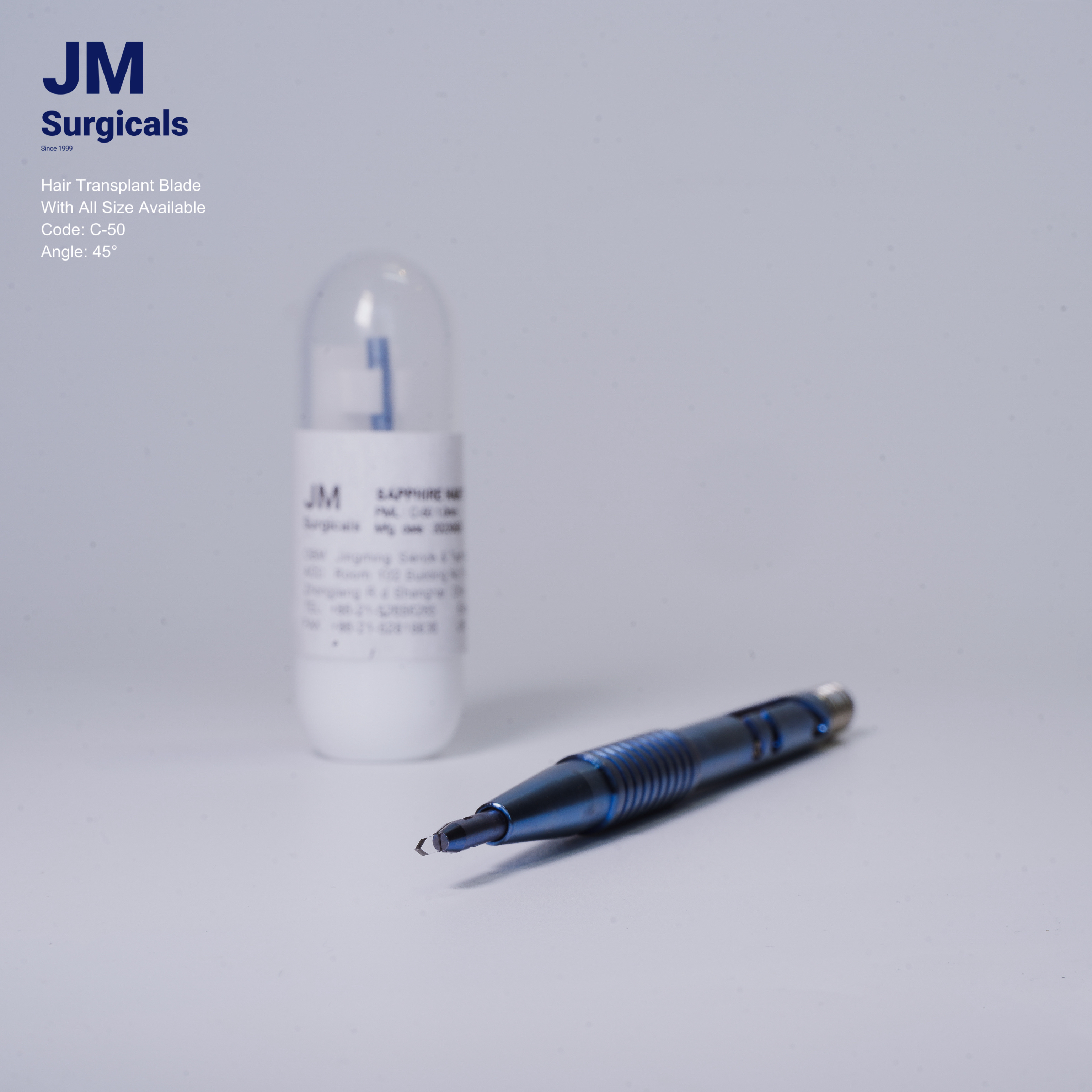
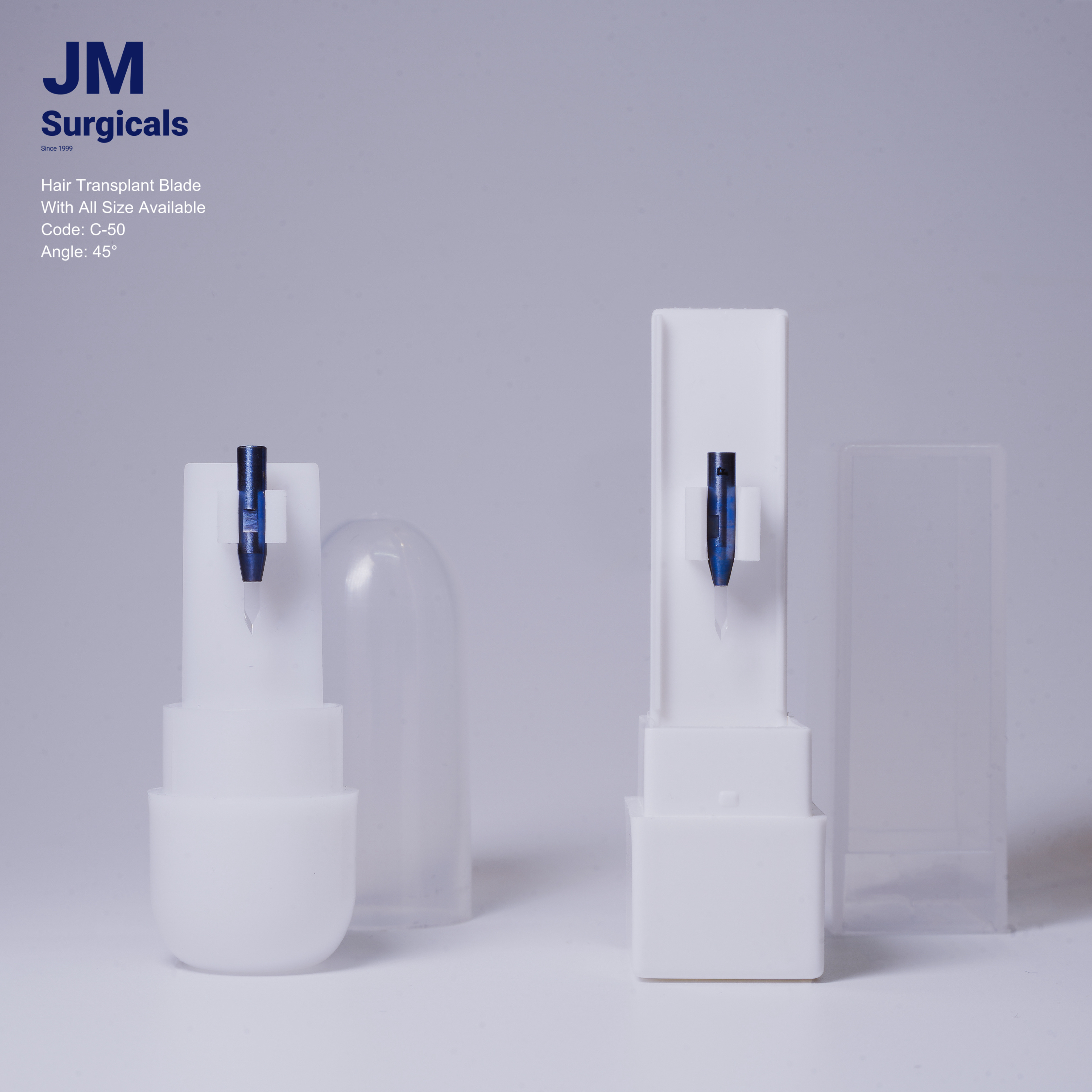
Sapphire blade with blue handle beside clear capsule packagingGroup of sapphire blades in clear capsule packagingBlades mounted in white holders with clear protective covers

Where This Width Earns Its Place

  • Day-to-day recipient-site work in a clinic list, where this sapphire hair transplant blade has to behave identically from the first case to the last.
  • Frontal and mid-scalp zones built around 2- and 3-hair units.
  • Teaching sessions, because the geometry repeats from blade to blade: a trainee can be given one entry angle and one depth and stay with that setup.
  • Repair and revision areas, where previously operated tissue feels firmer under the tip and a polished edge passes without drag.
  • Sensitive regions beside hair that is already growing, where this micro incision hair transplant blade keeps the incision small and clean.
  • Research and regenerative work, where the protocol calls for a controlled, small-diameter excision.

Ordering, Packing and Lead Times

Item Detail
Minimum order (overseas) 100+ pieces
Packing neutral and custom packaging options
Lead time, 1–500 pieces 10 days
Lead time, over 500 pieces Confirmed with our team
Logo customization From 300 pieces
Graphic customization From 1,000 pieces
Custom packaging From 5,000 pieces
Non-standard widths and angles Ground to your specification
Warranty 12 months
Shelf life 5 years
After-sales support Remote operation training

Working Length Selection

  • Working length is the cutting section measured from the tip to where the blade seats into the handle, and the C-50 family offers three: 4.5 mm, 5.0 mm and 5.5 mm. It changes how much blade sits between your grip and the incision. It does not change the channel width or the body, so swapping length never moves the width your team standardised on.
  • 4.5 mm — the shortest of the three. The tip sits closest to the handle, which gives the most direct feedback through the fingertips and the least blade to keep steady while you work through a tight grid. Surgeons who brace the hand against the scalp to control depth tend to prefer it.
  • 5.0 mm — the middle option and the usual starting point when a team writes one length into its protocol. It keeps the tip clear of the fingers during frontal and mid-scalp work at either the 45° or 60° tip, without putting extra blade into the field of view.
  • 5.5 mm — the longest. Choose it where the grip naturally sits further back: crown work reached from above, dense packing sequences where the wrist closes, or any setup where the hand obscures the incision at 4.5 mm.
  • To judge it on your own cases, mount a blade in its pen-style handle and bring the tip to the scalp at your usual depth. If your knuckles or the handle shoulder block the view of the incision, step up to the next length. If the tip feels remote and you are steering from the wrist rather than the fingers, step down.
  • Fix one length per team rather than stocking all three on the tray. Depth and entry feel are learned against a single working length, and mixing them mid-list reintroduces the variable a trainee is trying to control. A second length kept as a backup for unusual cases is enough for most clinics.
  • Length and angle are separate decisions. A 45° or 60° tip sets the entry geometry; the working length sets how much blade you have to manage. A 5.5 mm precision hair transplant blade at 60° and a 4.5 mm blade at 60° cut the same angle — only the reach differs.
  • Put width, length and angle on the order together so the box that arrives matches the protocol sheet.

Technical Support & Model Matching

Because we manufacture in-house, technical questions go straight to the engineers who build the instruments. JM Surgicals has been a surgical instrument manufacturer since 1999, with a team of more than 100 people, and we work alongside clinics, hospitals, private surgeons and distributors to match the right specification to each surgeon's technique and existing instruments — and to say honestly when a custom size, neutral packing or own-brand packing suits the order better. Support carries on after delivery: our team answers handling, sterilisation and reprocessing questions, helps troubleshoot anything that behaves unexpectedly, and turns custom requests around quickly. Tell us what you need to achieve and we will confirm what we can build for you.

FAQ

Q1. How does this width behave differently from 1.0 mm?

It gives the graft more room. A 2- or 3-hair unit that needs a nudge to settle at the narrower width drops in on the first pass here, while the incision stays within micro-incision limits. Because this micro incision hair transplant blade shares the same body as the narrower version, it does not feel heavier or stiffer in the hand.

Q2. What are the exact dimensions?

Width 1.1 mm, body thickness 0.25 mm, working lengths of 4.5 mm, 5.0 mm and 5.5 mm, and a tip cut at 45° or 60°. Each piece is ground from high-hardness sapphire in our own sapphire surgical blade factory and hand-polished at the edge, then checked under magnification before it is packed.

Q3. Are there handle options, and can we colour-code widths?

Yes. The blade fits a slim pen-style handle supplied in blue or silver, and teams commonly use the colour to mark widths on the tray so assistants can pick the right one without reading a label. Either colour takes the same blade and the same working lengths, so colour coding is a tray convention rather than a separate order.

Q4. How long can one blade stay in rotation?

Sapphire resists corrosion and keeps its geometry through repeated high-temperature sterilisation, so the practical limit is the edge rather than the material, and the blade can follow your normal instrument loop. We do not publish a fixed cycle count; inspect the tip under magnification before each case and retire the blade at the first sign of drag. An ultra sharp FUE blade should enter with almost no pressure, and once you are pushing it is time for a new one.

Q5. Can we order a width, length or angle outside the standard set?

Yes. The stocked family runs from 0.7 mm to 1.7 mm in width, with working lengths of 4.5 mm to 5.5 mm and 45° or 60° tips; anything outside that is ground to order as a custom size FUE blade. Tell us the width, length and angle your protocol uses and we will confirm what can be built.

Download

We use Cookie to improve your online experience. By continuing browsing this website, we assume you agree our use of Cookie.