
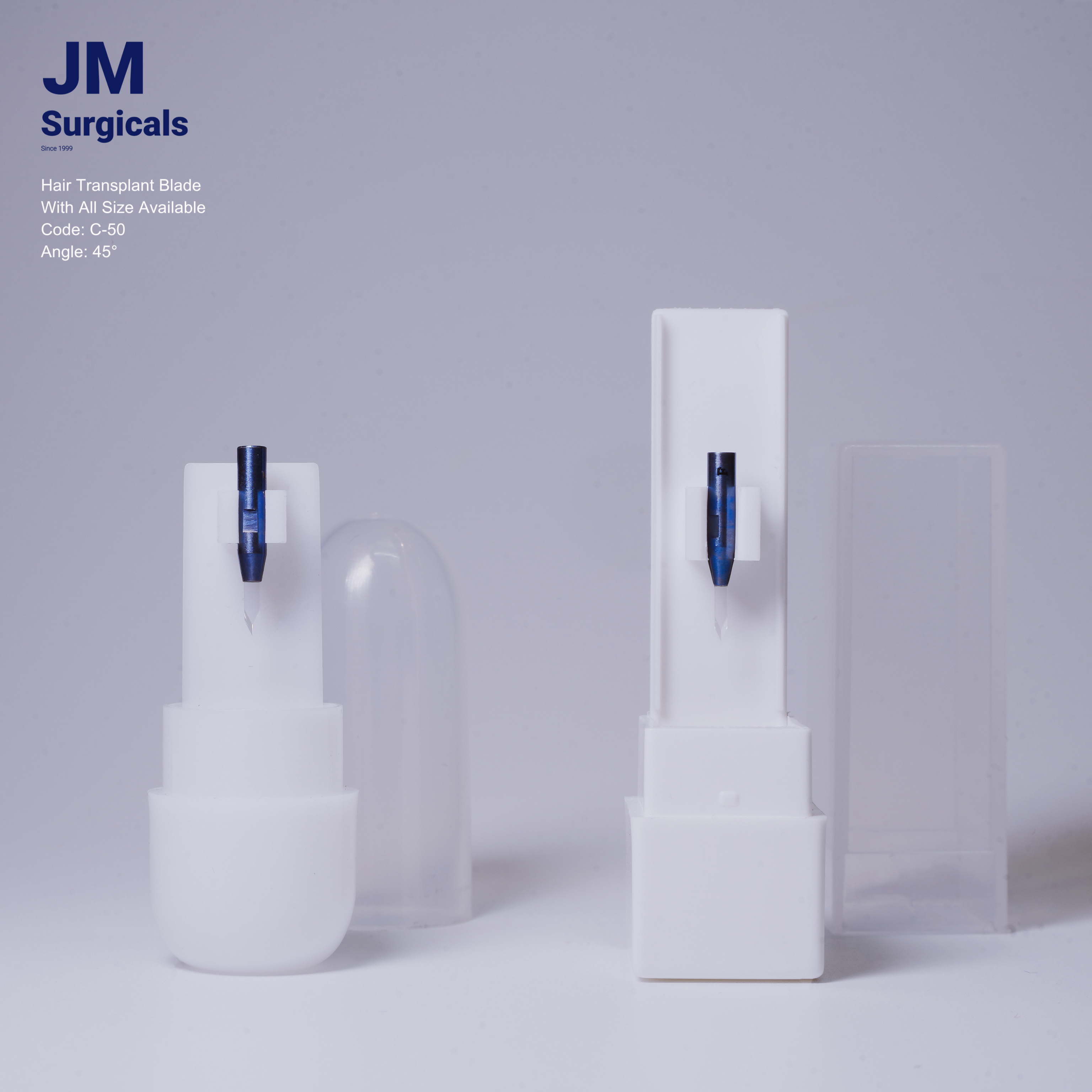
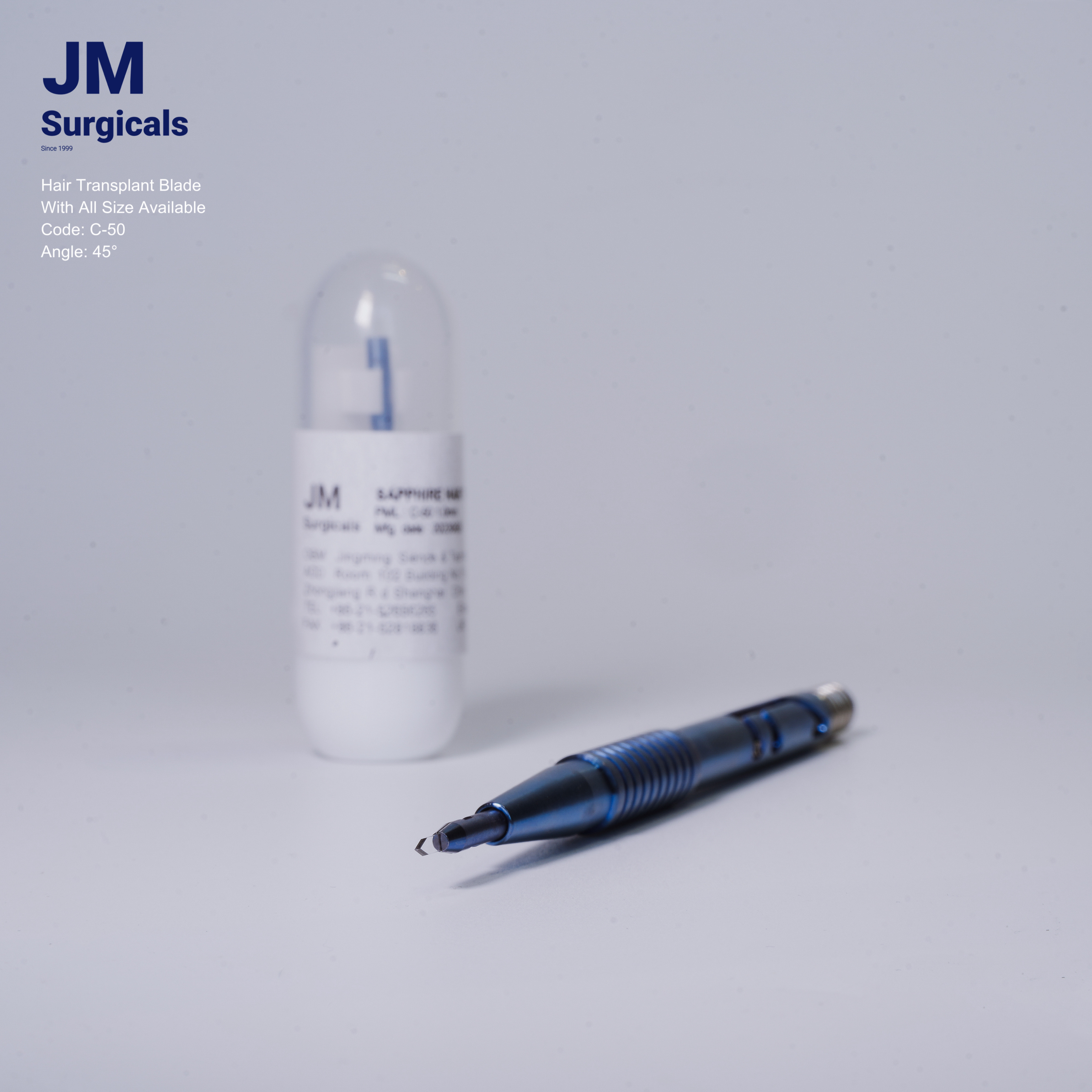
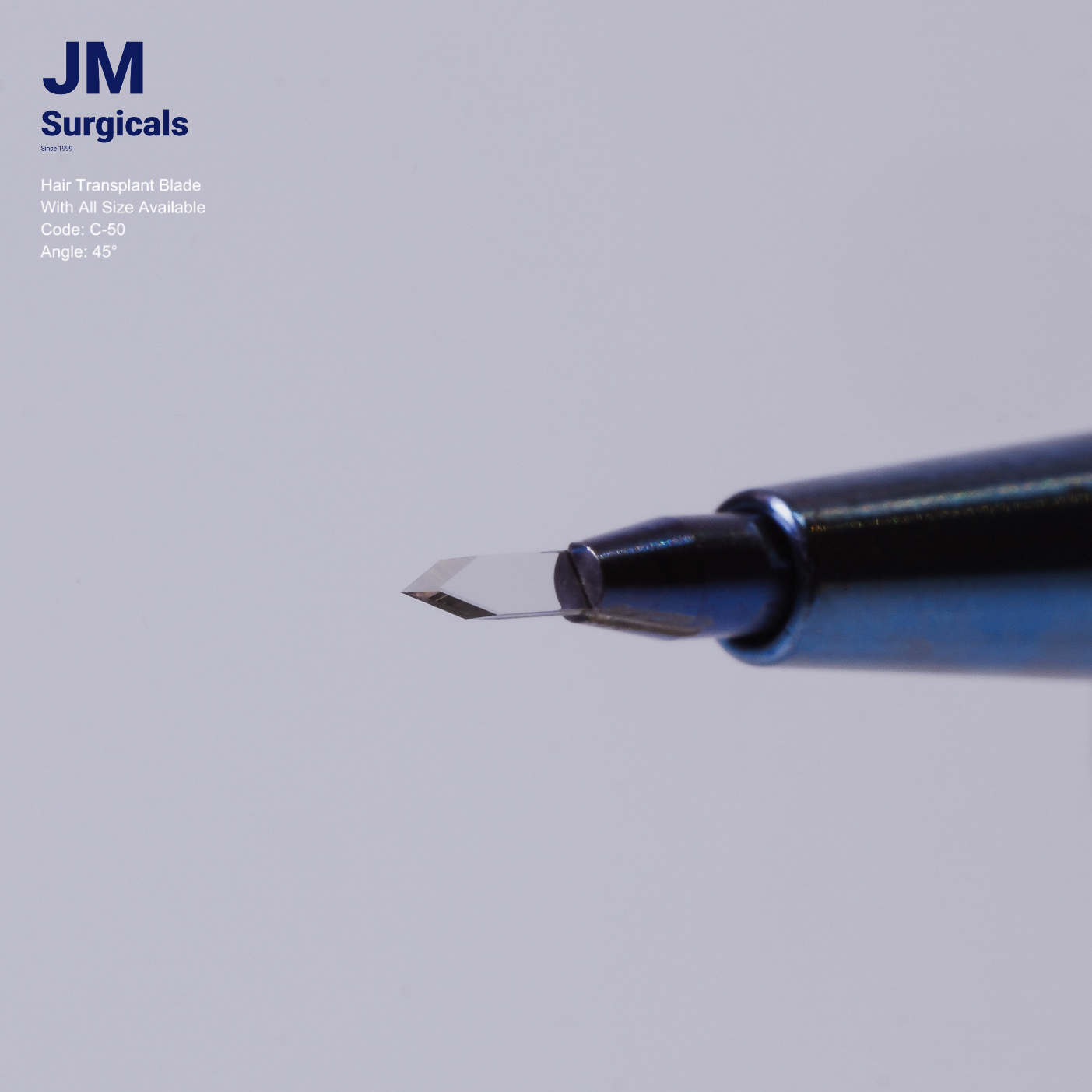
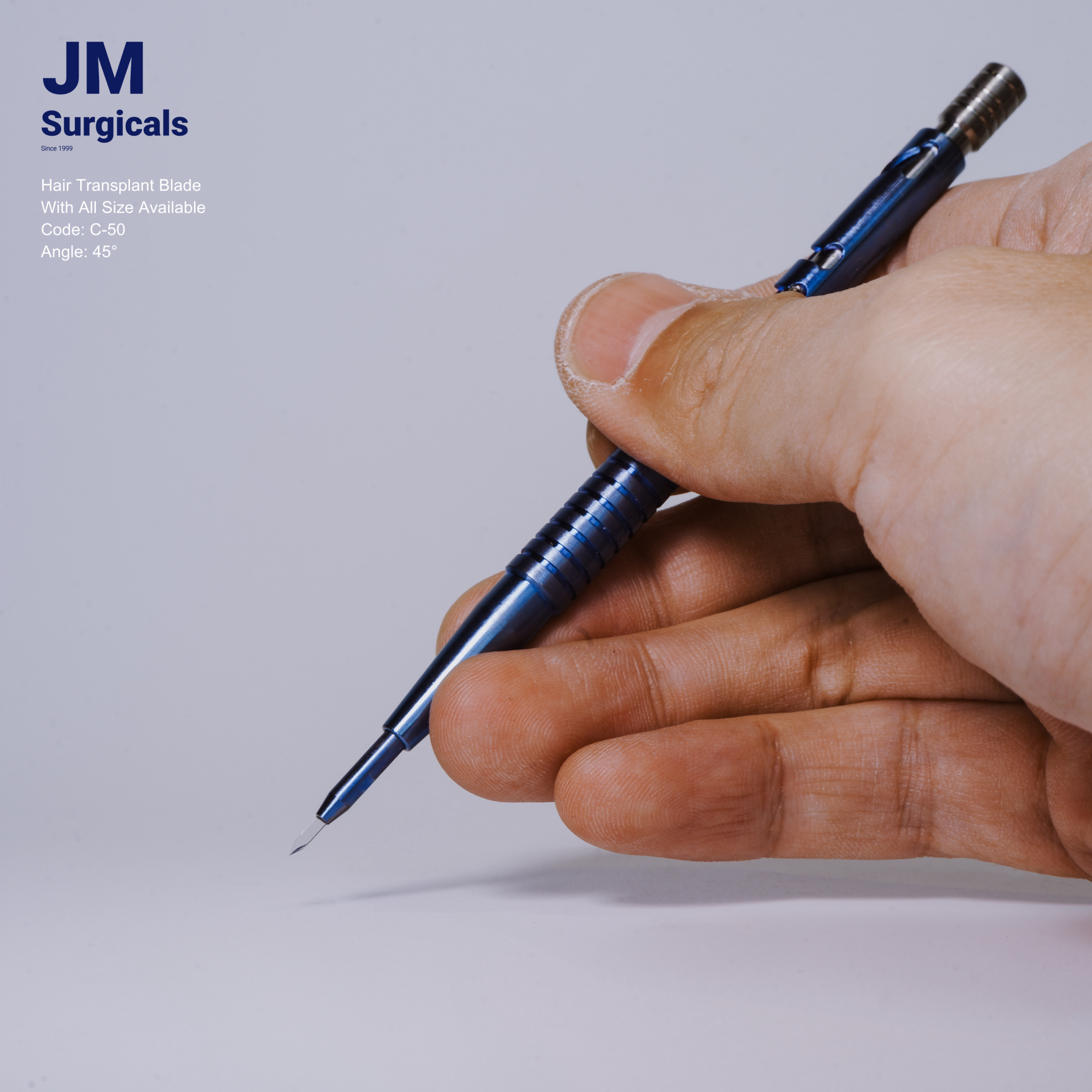
The 1.15mm sapphire hair transplant blade offers precision and durability for follicular unit extraction procedures. Designed with low trauma hair transplant blade technology, this custom size fue blade ensures minimal tissue damage and optimal surgical performance.


The 1.15 mm sapphire hair transplant blade is a recipient-site instrument for follicular unit extraction — the blade that opens each slit before a graft is seated. It mounts on the same handle as every other C-50 width, and the thickness, cutting angle and blade lengths that go with this width are set out in the C-50 specification.
Surgeons rarely arrive at this size by habit. They work a list, find 1.1 mm slightly tight for the density they planned and 1.2 mm slightly more than the site needs, and ask for the measurement in between. That request is what this blade answers — a channel tuned to the plan instead of rounded to the nearest stocked width.
Clinics order it for recipient-site work in their FUE programmes, hospital plastic surgery and dermatology departments keep it alongside their other widths, and distributors stock it under neutral or own-brand packing for the clinics they supply. It belongs in an operating theatre, not in a salon or a micropigmentation studio.
Each blade is ground, polished and inspected in our own sapphire surgical blade factory, which has been making surgical instruments since 1999.

| Model | C-50 |
|---|---|
| Product reference | PTC501150001 |
| Blade width | 1.15 mm |
| Blade thickness | 0.25 mm |
| Blade lengths | 4.5 mm, 5.0 mm, 5.5 mm |
| Cutting angles | 45° and 60° |
| Material | High-hardness sapphire |
| Blade finish | Transparent body, smooth-ground and hand-polished edge |
| Intended use | Recipient-site incision in follicular unit extraction |
| Handle options | Blue or silver |
| Individual packaging | High-temperature resistant case with dust cover |
| Width range across the family | 0.7 mm to 1.7 mm |


Hardness is the point. Sapphire keeps a polished edge far longer than the stainless steel used for many slit blades, and it does not corrode when it meets steam, saline or repeated cleaning. On a width this specific, that consistency is the whole value: the channel you opened at the start of a zone should feel the same at the end of it.
A polished edge, not just a sharp one. Each blade is ground and hand-polished, then checked for sharpness, toughness, edge retention and resistance to rust. A tip that rolls on the first dense pass wastes the whole point of a fine edge, which is why uniformity along the full length is judged as strictly as the point itself.
Readable where it matters. The sapphire body is transparent, so the tip and the depth of the channel stay visible against scalp tissue under theatre light.
Why it is called low trauma. We build this as a low trauma hair transplant blade for a mechanical reason rather than a promotional one: a polished edge parts tissue instead of dragging through it, so the channel walls stay intact and the graft has a clean seat.
Made where it is ground. Grinding and polishing happen in our own sapphire surgical blade factory, so the edge specification stays the same from one width in the family to the next.

| Minimum order, overseas | 100+ pieces |
| Packaging options | Neutral and custom packaging options |
| Custom size FUE blade | Length and angle to your specification |
| Logo customization | Minimum 300 pieces |
| Graphic customization | Minimum 1,000 pieces |
| Custom packaging | Minimum 5,000 pieces |
| Lead time, 1–500 pieces | 10 days |
| Lead time, over 500 pieces | To be negotiated with our team |
| Warranty | 12 months |
| Shelf life | 5 years |
| After-sales support | Remote operation training |

The angle is a tip measurement. The 45° and 60° figures describe how the cutting face meets the skin as the blade enters: a flatter or a more upright relationship between the edge and the surface of the scalp. Each C-50 blade is ground to a single angle, so this is settled when the order is written, not adjusted in the room once the box is open.
Reading the 45°. The blade lies closer to the surface, so the channel runs more obliquely and the graft is seated on a shallower line. Surgeons reach for it where the planned hair direction is flat to the scalp and the exit angle has to follow — frontal hairline work, temple points, and the transition zones where a steep channel would show.
Reading the 60°. The blade stands more upright, producing a channel closer to perpendicular. This is the choice where the hair grows more upright — crown and vertex — and where the surgeon wants the blade to sit up out of the tissue rather than lie along it during dense packing.
Direction is decided with the angle, not after it. The channel a graft sits in has to run the way that hair will fall, and the blade angle is half of that decision; the other half is the direction you hold it. Many teams settle both on the hairline first, then keep the same angle and direction across the rest of the recipient area so the pattern stays consistent.
The angle changes the width question. Two blades of the same 1.15 mm width ground at different angles do not open the same footprint in tissue. Fix the angle for the case before you compare 1.1 mm, 1.15 mm and 1.2 mm — otherwise you are judging two variables at once and the width that suits your plan can look wrong.
Both angles in one order. A list that mixes hairline and crown work often needs both. They are separate line items — the angle is part of the specification alongside width and length — so write 45° or 60° against the quantity of each rather than assuming one covers the case.
Angles beyond the two standard options. Blades ground to a different angle are built to your stated specification. Send the angle, width and length together and our engineering team will confirm what can be produced before the order goes into the schedule.

Because we manufacture in-house, technical questions go straight to the engineers who build the instruments. JM Surgicals has been a surgical instrument manufacturer since 1999, with a team of more than 100 people, and we work alongside clinics, hospitals, private surgeons and distributors to match the right specification to each surgeon's technique and existing instruments — and to say honestly when a custom size, neutral packing or own-brand packing suits the order better. Support carries on after delivery: our team answers handling, sterilisation and reprocessing questions, helps troubleshoot anything that behaves unexpectedly, and turns custom requests around quickly. Tell us what you need to achieve and we will confirm what we can build for you.
It is thin enough that the edge slices rather than pushes, and rigid enough that it does not wander off the line you set. Every width in the C-50 family shares the same 0.25 mm thickness, so moving from one sapphire FUE blade to another changes the channel, not the feel in your hand.
Each blade is ground to the stated 1.15 mm width and inspected before packing. We do not publish a numeric tolerance window here; if your protocol needs one written down, tell us the window you work to and we will confirm what we can state for your order.
It is the width many teams choose when the density plan needs a tighter channel than 1.2 mm allows. A high density FUE blade plan needs channel room that grafts seat into quickly without enlarging the wound, and the 0.05 mm step between widths is usually where that balance sits. If your density targets vary from case to case, keep this width and one neighbour on the tray.
4.5 mm, 5.0 mm and 5.5 mm share the same edge geometry. The longer options simply give more blade to hold when the approach is deeper or the surgeon grips further back, so most teams order the length they already work with and add a second length only when a technique calls for it.
Drag on entry, a need to press and a channel that wants a second pass are the usual signals. Inspect the edge under magnification at your protocol interval, whether that is counted in sites or in completed zones, and retire any blade that has been dropped or knocked against the tray. Keeping that interval consistent is what keeps a low trauma hair transplant blade behaving the same on the last site as on the first.
The blade is manufactured under an ISO 13485 quality system and classified as a Class I medical device. Both are properties of the C-50 family, so every width you order from it is released to the same standard.


